Invisible ramps: Universal Design for Learning in virtual spaces
From architecture to the classroom
UDL is organised around three questions: why we learn (engagement), what we learn (representation) and how we show what we know (action and expression) (CAST, 2024). Research supports its potential, with moderate positive effects on achievement (King-Sears et al., 2023), but it also warns of a risk: reducing UDL to a list of tools. UDL is not about offering many options, but meaningful options that serve the same learning goal.
A walk through the virtual campus
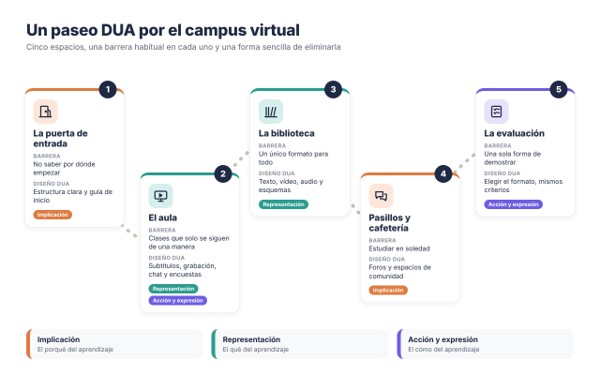
Figure 1. A UDL walk through the virtual campus
The entrance. If, on entering, students find a clear structure, a getting-started guide and an organisation that is repeated from one unit to the next, they know where they are and what is expected of them. The challenge here is a shared one: on many campuses each course is organised differently, and students have to relearn the "building" every time. Agreeing on a common structure across a degree programme is one of the simplest measures and, at the same time, one of the least applied.
The classroom. Captions are the best example of a measure designed for a few that ends up benefiting almost everyone. In a study of more than 2,000 university students, 71% of those without hearing difficulties used captions at least some of the time (Linder, 2016), and the evidence points to gains in comprehension and recall for any viewer (Gernsbacher, 2015). Platforms now generate captions automatically, but they should be checked: a technical term transcribed incorrectly becomes a new barrier.
The library. Offering the same content in different formats (a text, a short video, a diagram, an audio clip) opens more doors to the same knowledge. But format does not guarantee access: a scanned PDF cannot be read by a screen reader or easily enlarged. In Spain, regulations already require public universities to make their websites and apps accessible (Royal Decree 1112/2018); UDL goes one step further and seeks to provide different ways of understanding.
The hallways and the café. On a physical campus, much learning happens outside the classroom. Online, these spaces have to be created on purpose, and this is one of the greatest challenges: a forum does not create community on its own, and many end up empty or turned into notice boards. Research on communities of inquiry shows that social presence has to be cultivated (Garrison et al., 2000): open questions, teacher replies that invite further conversation and spaces with a clear purpose.
Assessment. We do not all show what we know in the same way. Letting students choose between a written text, a recorded presentation or a concept map, with the same criteria, helps to measure learning rather than skill with a single format. This flexibility has added value today: in the face of generative artificial intelligence, combining formats, such as a short oral defence or a process portfolio, makes assessment more inclusive and also more authentic. A common rubric for all options keeps the marking workload from multiplying.
Designing from the start
Author:
GIETE – Research, Evaluation and Educational Technology
University of Sevilla