Breaking the Silence of the Classroom: The Struggle Against Epistemic Injustice in the Public University
The Problem: Academic Capitalism and Silent “Epistemicide”
- The Tyranny of the Market (Academic Capitalism): Today, university research and teaching are heavily constrained by economic profitability criteria, citation impact metrics, and fundraising capabilities. Fields or methodologies that do not yield immediate profits see their developmental spaces curtailed (Bacevic, 2023; Pereira, 2015).
- The Monopoly of Knowledge: University curricula remain largely dominated by a eurocentric, androcentric, and elitist vision (“white, European, and North American men”), which marginalizes thought generated in the Global South or from feminist and community traditions (Medina, 2022b).
- Epistemic Injustice: This occurs when individuals are stripped of their status as “knowers.” In the university context, this translates into the devaluation of community-based experience, framing it as “second-rate knowledge” compared to traditional academic rigor (Fricker, 2007).
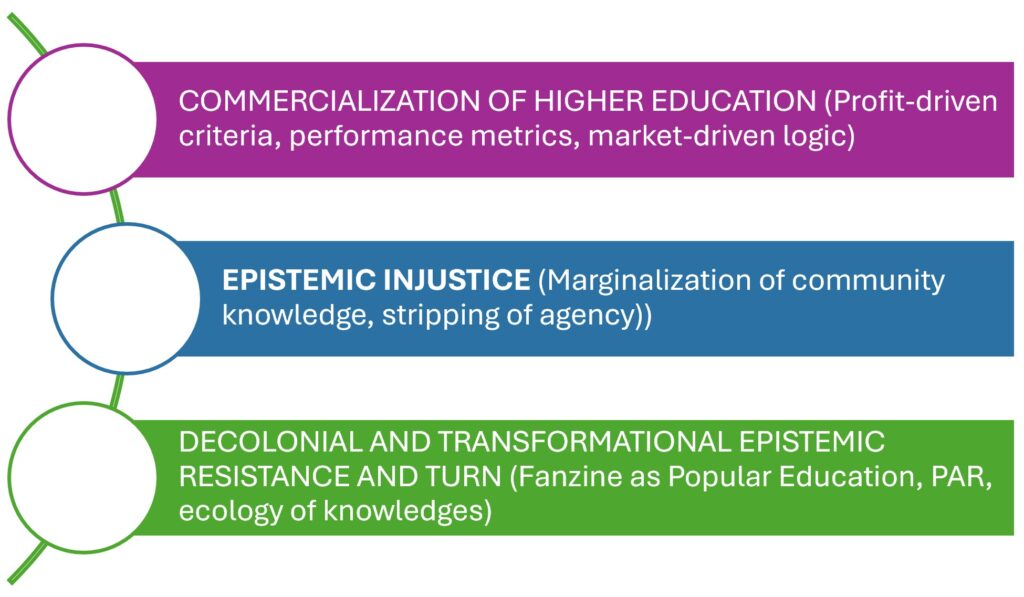
To analyze the subjective and institutional impact of these dynamics, turning to the theory of epistemic agency and epistemic injustice becomes indispensable. Epistemic agency refers to the capacity of individuals and collectives to participate actively in the creation, interpretation, discussion, and validation of knowledge within a community (Medina, 2022a). When institutions unfairly deprive or restrict the ability of subjects to act as legitimate possessors of knowledge, a direct violation occurs, which Medina (2021) describes as agential epistemic injustice.
Going beyond the initial classification proposed by Miranda Fricker (2007)—who bounded epistemic injustice to its testimonial and hermeneutical branches as predominantly individual shortcomings or unintentional structural failures—Medina (2022b) posits that harm to epistemic agency often stems from deliberate insensitivity or ignorance. This arises when dominant institutions or groups actively refuse to understand, learn, or utilize the conceptual frameworks and terminologies developed by vulnerable or minoritized collectives (Medina, 2022b).
In everyday university practice, epistemic injustice manifests through the invisibilization of research stemming from the Global South, the underestimation of community knowledge, and the reproduction of an androcentric and eurocentric curriculum. Faced with this phenomenon of epistemicide, popular education and decolonial pedagogies emerge as trenches of resistance capable of dismantling the “monoculture of knowledge” and restoring agency to silenced collectives by recognizing them as authentic, active subjects of knowledge.
Taking Action: 12 Focus Groups and the Power of the Fanzine
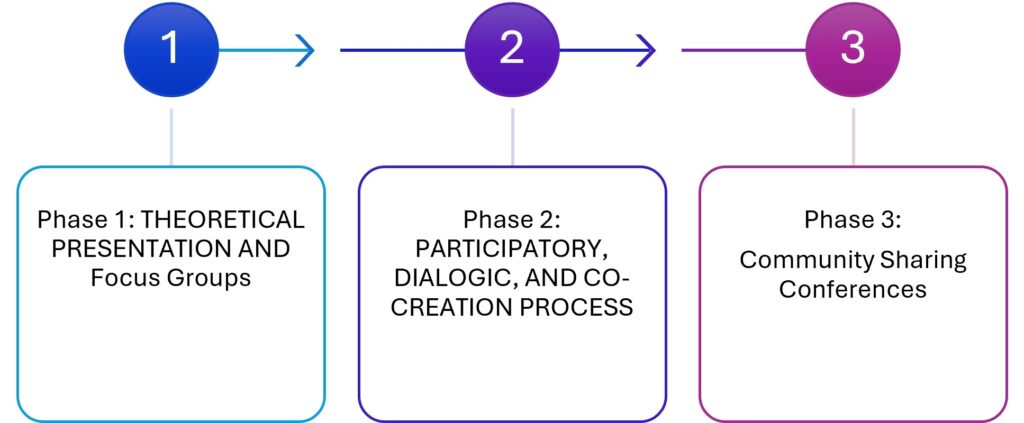
Through illustrations, poetry, collages, and reflective texts, students managed to break the traditional logic that views vulnerable groups merely as "objects of study." Instead, fanzines enabled their recognition as what they truly are: full subjects of knowledge and transformation.
The Fanzine as a Participatory Methodology and Popular Education Tool in the University
Historically, the fanzine (fan magazine) emerged on the fringes of official culture as a self-published, non-commercial, handcrafted, low-cost publication. Associated with countercultural movements, punk, Riot Grrrl feminism, and grassroots activism, the fanzine has traditionally served as a medium for communities unacknowledged by mainstream media to claim their voice, spread their demands, and construct collective identities.
By bringing the logic of the fanzine into higher education, an intentional subversion of the formal academic ecosystem takes place. The traditional university imposes the rigorous academic essay, standardized citation, and impersonal detachment as the only valid channels for knowledge transmission. Conversely, the fanzine democratizes textual and visual production, introducing the core principles of Popular Education formulated by Paulo Freire:
- Breaking with "Banking Education": In banking education, the educator "deposits" content into a student conceived as a passive container. The fanzine workshop demands that students assume the role of creator, researcher, and editor of their own message, shifting from object of teaching to subject of learning.
- The Principle of Self-Enunciation: Countering the requirement to speak through the neutral voice of the "expert," the fanzine encourages the use of the first-person plural ("we"). It allows knowledge to be articulated from lived experience, the body, emotion, and the student's situated location.
- Horizontality and Collective Production: Creating the fanzine in teams shifts away from individualistic, competitive work toward assembly-like dynamics of content negotiation, shared design, and collective decision-making.
Phases of the Fanzine Methodology as Popular Education Praxis
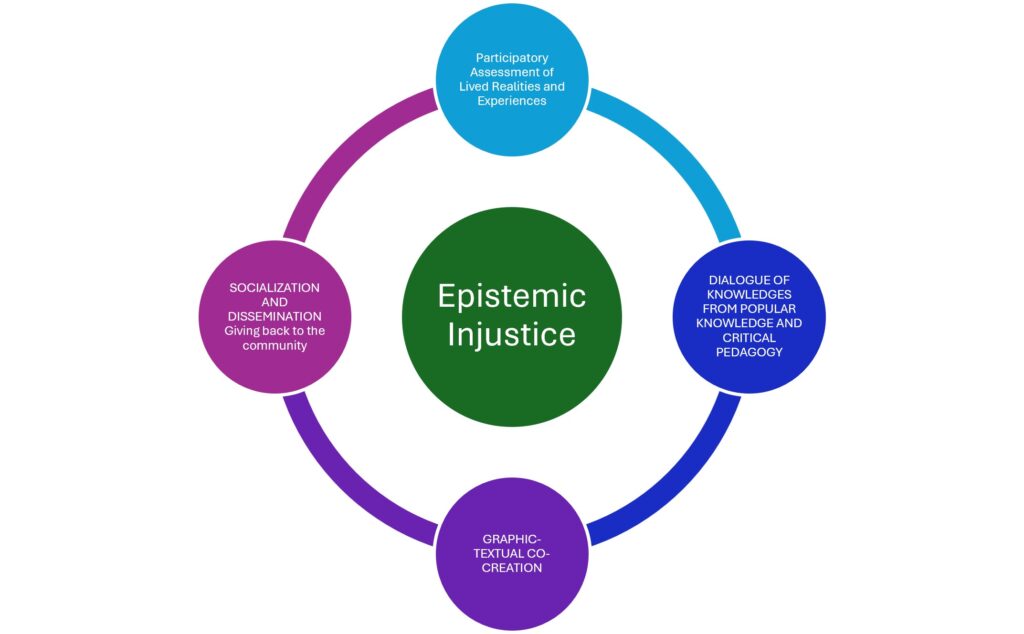
A. Participatory Diagnosis and Problematization (starting from situated realities)
In this initial phase, work groups do not begin by writing about abstract concepts, but by problematizing their own reality as Social Education students at the Complutense University of Madrid. Drawing on previous debate group discussions, students identify "generative words" and critical issues cutting through their lives: youth precariousness, the invisibilization of care work, institutional racism, mental health, or the exclusion of popular knowledge from course syllabi.
B. Research and Dialogue of Knowledges (Saberes) (theorizing from practice)
Once the thematic core of the fanzine is selected, the group begins a process of dialogic inquiry. Here, academic bibliographic sources (Freire, bell hooks, Yayo Herrero, María Lugones) are consulted alongside non-academic knowledges: testimonies from social movements, interviews with neighborhood entities, song lyrics, poems, autobiographical accounts, and community photographic archives. An authentic ecology of knowledges takes shape, where theory builds bridges with everyday experience.
C. Textual-Graphic Co-creation and Expressive Languages
The physical or digital design phase of the fanzine serves as an exercise in aesthetic democratization. Through collage, cut-outs, hand lettering, drawing, photocopying, and visual poetry, the dictatorship of plain academic text is disrupted. This variety of languages brings forth non-verbal capabilities and creative talents often ignored by the traditional university, facilitating the inclusion of students who face difficulties with formal academic writing.
D. Socialization, Feedback, and Dissemination (transformative practice)
In Popular Education, knowledge is not produced to be archived or privately graded by an instructor; it is produced to return to the community and spark action. The fanzines created by the students do not end up locked away in a virtual learning platform; they are printed, photocopied, distributed, and publicly presented during socialization events and exchanges with social movements, neighborhood associations, and other members of the university community.
Analysis of Findings and Keys to Transformation: From University to Pluriversity
- Decolonizing the Curriculum, Denouncing Commercialization and Hegemony: Adding optional readings is not enough.
"The current educational model suffocates social responsibility by being exclusively oriented toward 'economic profitability', memorization, and 'competitiveness'" (Focus Group 3).
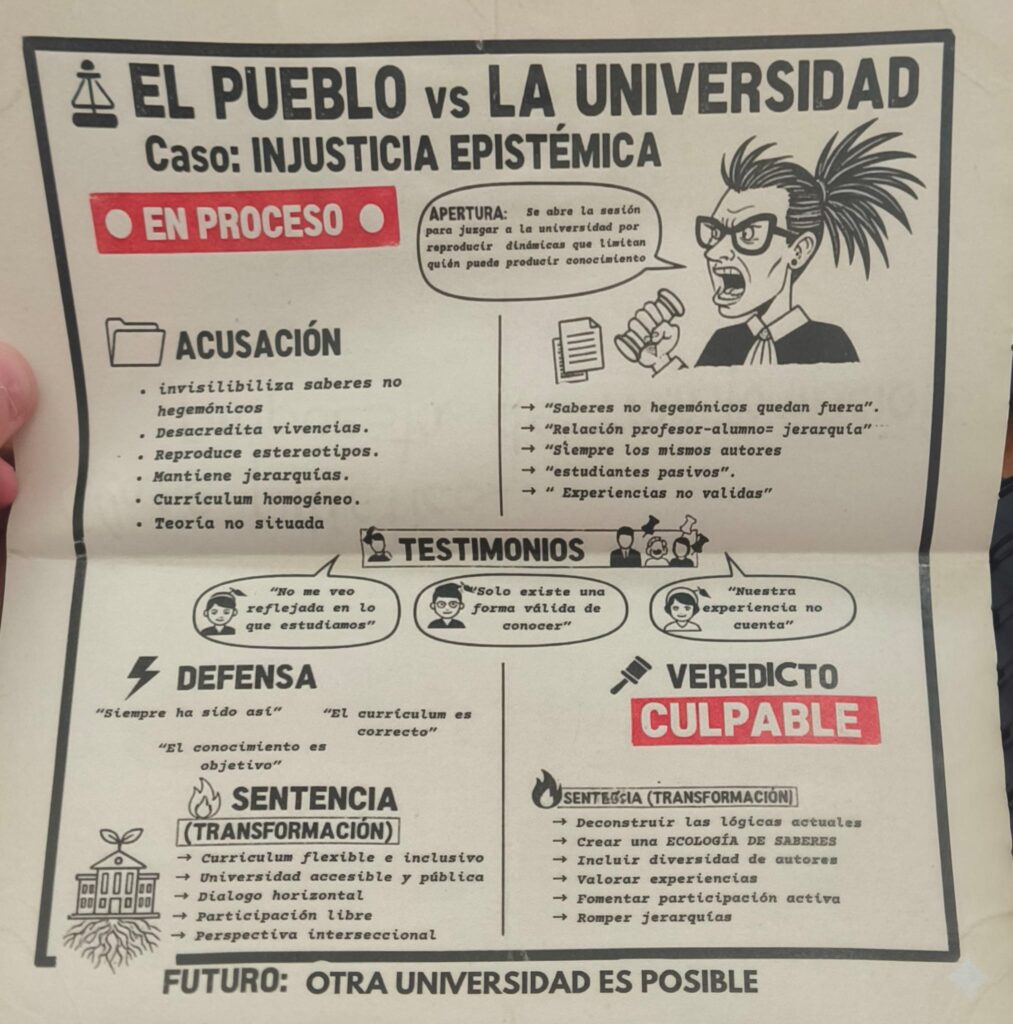
Images: Examples of Fanzines from the Lifelong Education group, UCM. Shift M1. '025-26
- Recognizing the Ecology of Knowledges and Manifestations of Epistemic Injustice and Epistemicide: It is essential to value fieldwork and alliances with social movements as legitimate sources of knowledge, alongside problematizing language as a class filter and the hierarchization of knowledge systems.
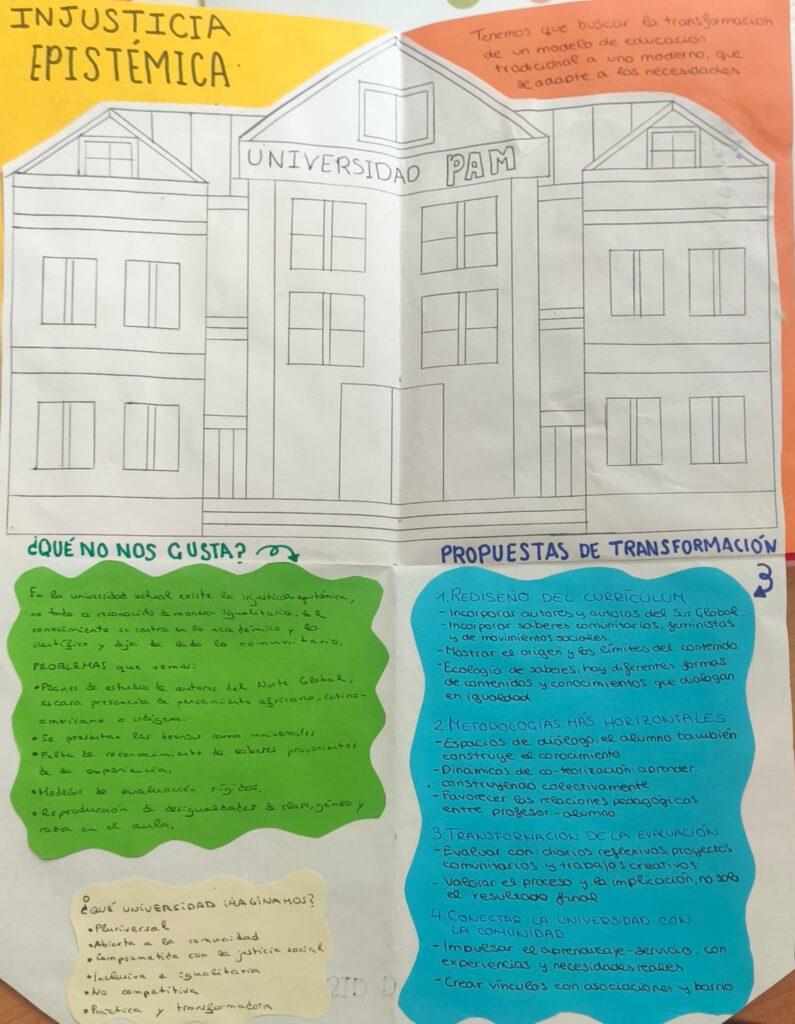
- Building a Pluriversity and the Fanzine as a Tool for Decolonization and Epistemic Turn: We need an open institution connected to its surrounding territory, placing the ethics of care, intersectionality, and social justice at the center.
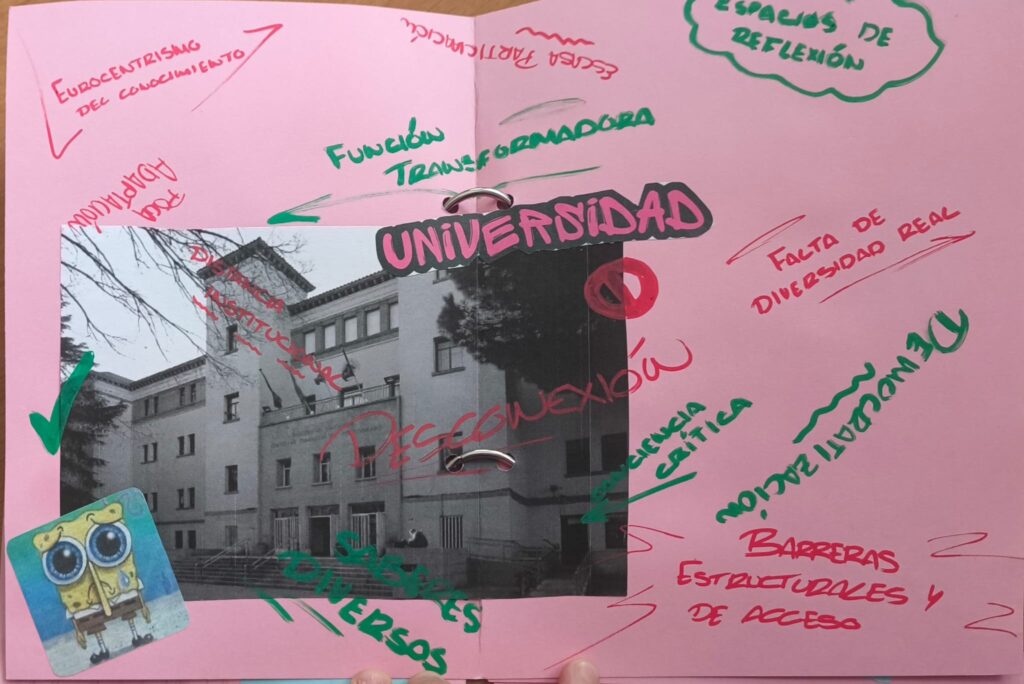
Guaranteeing critical public university education is neither a luxury nor a secondary option; it is an irreplaceable ethical commitment to achieving a genuinely democratic and inclusive society.
References
Bacevic, J. (2023). Epistemic injustice and epistemic positioning: Towards an intersectional political economy. Current Sociology, 71(6), 1122–1140. https://doi.org/10.1177/00113921211057609
Fricker, M. (2007). Epistemic injustice: Power and the ethics of knowing. Oxford University Press.
Medina, J. (2021). Agential epistemic injustice and collective epistemic resistance in the criminal justice system. Social Epistemology, 35(2), 185-196. https://doi.org/10.1080/02691728.2020.1839594
Medina, J. (2022a). Group agential epistemic injustice: Epistemic disempowerment and critical defanging of group epistemic agency. Philosophical Issues, 32(1), 320-334. https://doi.org/10.1111/phis.12221
Medina, J. (2022b). Activismo epistémico y la epistemología del empoderamiento. Quaderns de filosofia, 9(2), 19-26. https://doi.org/10.7203/qfia.9.2.22954
Pereira, M. D. M. (2015). Higher education cutbacks and the reshaping of epistemic hierarchies: An ethnography of the case of feminist scholarship. Sociology, 49(2), 287–304. https://doi.org/10.1177/0038038514541334
Author:
Irene Martínez Martín
Jose Manuel Sánchez Serrano
INDUCT Research Group
Complutense University of Madrid