Screens in Early Years Education? Beyond the Ban: Realities, Myths and Research-Based Proposals
A recently defended doctoral thesis, entitled “El uso de recursos educativos digitales en la infancia: prácticas tecnológicas de niñas y niños de 3 a 6 años en Canarias” (The use of digital educational resources in childhood: technological practices of children aged 3 to 6 in the Canary Islands), aimed to conduct a diagnostic-descriptive review of how children in the second cycle of Early Years Education consume and interact with Digital Educational Resources (DERs). To achieve this, the study examined the current landscape from multiple angles: the digital catalogue provided by the public administration, the perspectives of families and teachers in this educational stage, and the criteria of a multidisciplinary panel of professionals.
What are the actual dynamics in homes and schools? What does science tell us when we look at the reality on the ground? Below are the main conclusions and proposals drawn from this research.
1. The analysis of institutional repositories: an uneven starting point
The first stage of the thesis (Study 1) involved analysing the catalogue of Digital Educational Resources that the local public administration makes available to schools—specifically, the Canary Islands Government’s institutional portal, EcoEscuela 2.0.The conclusion is clear: although there are highly valuable interactive materials and engaging, play-based proposals, many of the available resources lack a pedagogical design truly tailored to the 3-to-6 age group. Materials are frequently conceptualised from a purely transmissive perspective or offer only rudimentary interactivity. There is an urgent need to redesign these repositories so that DERs promote truly active, creative, and experiential learning that adapts to children’s developmental stages.
2. The home: the dilemma of work-life balance and lack of time
Study 2 focused on domestic dynamics through questionnaires and focus groups with families in the Canary Islands. The results reveal a clear gap between what mothers and fathers would like to do and what the demands of daily life allow them to do.- The screen as a lifeline: In many households, the use of digital devices becomes a quick, practical solution to the difficulties of balancing work and family life, fast-paced routines, and limited free time and suitable outdoor spaces for recreation. Screens frequently serve as an independent form of entertainment, allowing adults to attend to household chores or work responsibilities without leaving their urban environment.
- Passive consumption vs educational use: Due to this lack of time, safe spaces, and, at times, insufficient digital literacy among caregivers, young children’s media consumption is predominantly passive and recreational (an endless loop of videos on streaming platforms or fast-paced commercial games saturated with advertising). This displaces opportunities for active, shared, and mediated use with educational or creative purposes.
3. The classroom: willing teachers, but lacking resources, time, and training
Consulting Early Years teachers (Study 3) revealed a mixed picture, with both lights and shadows. Contrary to the stereotype of the technophobic teacher, the research showed that in the Canary Islands, there is a strong willingness to embrace change and a notable awareness of the importance of digital competence in today’s society.However, to establish a coherent and pedagogical use of technology in the classroom, teachers face three major barriers:
- Inadequate infrastructure: Many schools lack the necessary connectivity or devices to implement high-quality digital activities on a daily basis.
- Lack of specific training: Teacher training tends to focus on the technical handling of tools rather than on the pedagogy of technology for the 3-to-6 age group.
- Lack of home-school coordination: There is a pressing need to develop educational policies that foster a shared digital culture between schools and families, ensuring both environments pull in the same direction.
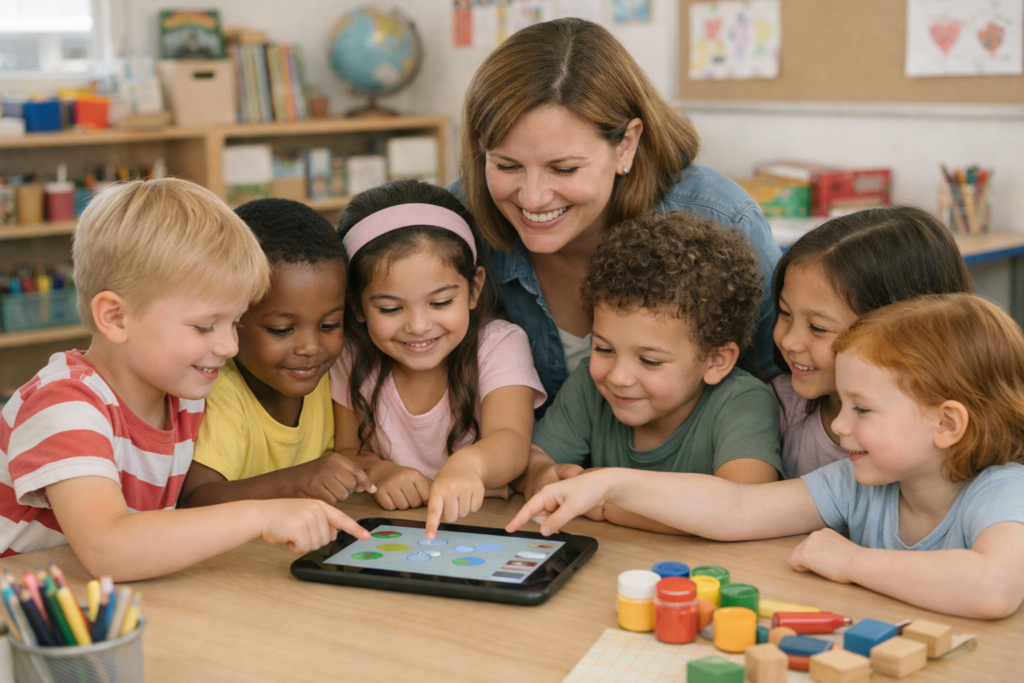
Image created with AI (Microsoft Copilot). Illustrative representation, not a real photograph
4. The experts’ voice: a critical balance
Finally, Study 4 convened a panel of professionals from various fields (psychology, pedagogy, paediatrics, and speech therapy) to compare their perspectives. Moving past the initial reservations typical of each discipline, the conclusions of this meeting highlight the need for a balanced approach: technology is neither inherently harmful nor magically educational; what matters is the quality and duration of use, the pedagogical intent, and adult mediation.Their views align on the fact that excessive, uncontrolled screen use has clear negative impacts on physical development (sedentary lifestyles, vision problems), language acquisition, sleep, and emotional self-regulation in childhood. However, they also argue that a well-selected DER, used with clear criteria, can be an excellent tool for supporting diversity in the classroom, stimulating curiosity, and offering practical, motivating learning solutions.
Towards a new model: from children as consumers to children as “prosumers”
What do we do, then, with all this information? The value of a doctoral thesis lies not only in the diagnosis it offers, but also in its capacity to put forward proposals for the future. The research concludes with a clear roadmap to transform children’s relationship with technology, built on three key pillars:- For families: Mediation, role-modelling, and alternatives. Adults must be the primary role models for healthy technology use, as observational learning is foundational in early childhood. Digital co-engagement should be prioritised (playing alongside children, asking them about what they are watching, and turning the screen into a space for verbal and emotional interaction rather than isolation). Nevertheless, acknowledging that technology is often used to manage work-life balance, providing households with alternative, screen-free entertainment resources and strategies remains an outstanding task.
- For teachers: Selection based on developmental criteria. Technology in the Early Years classroom must be a complementary resource with highly defined purposes. Teachers need specific training to learn how to filter and select DERs that respect their students’ cognitive maturity, whilst also fostering collective, active, interactive, imaginative, hands-on, and inclusive screen-based activities to enable and enhance the educational use of these devices.
- For pupils: becoming prosumers: This is perhaps the most urgent paradigm shift. We must educate children to move away from the passive consumption of algorithmically designed content and use technology to create. Devices should be used to follow a craft tutorial, document a project, follow a recipe, compose music, express themselves artistically, dance, meditate, exercise, connect with people from other cultures, program small robots, or actively learn languages.

Conclusion
A total ban on screens in childhood is an illusion that ignores the digital ecosystem in which newer generations inevitably grow up. On the other hand, unrestricted and excessive access is irresponsible. The answer lies in active mediation, continuous professional development for teachers, and a commitment to balanced digital environments. Only by building solid bridges between homes, schools, publishing companies, and public administrations (while also holding those who design these resources accountable) can we ensure that technology becomes a window of creative opportunity rather than an obstacle to children’s development.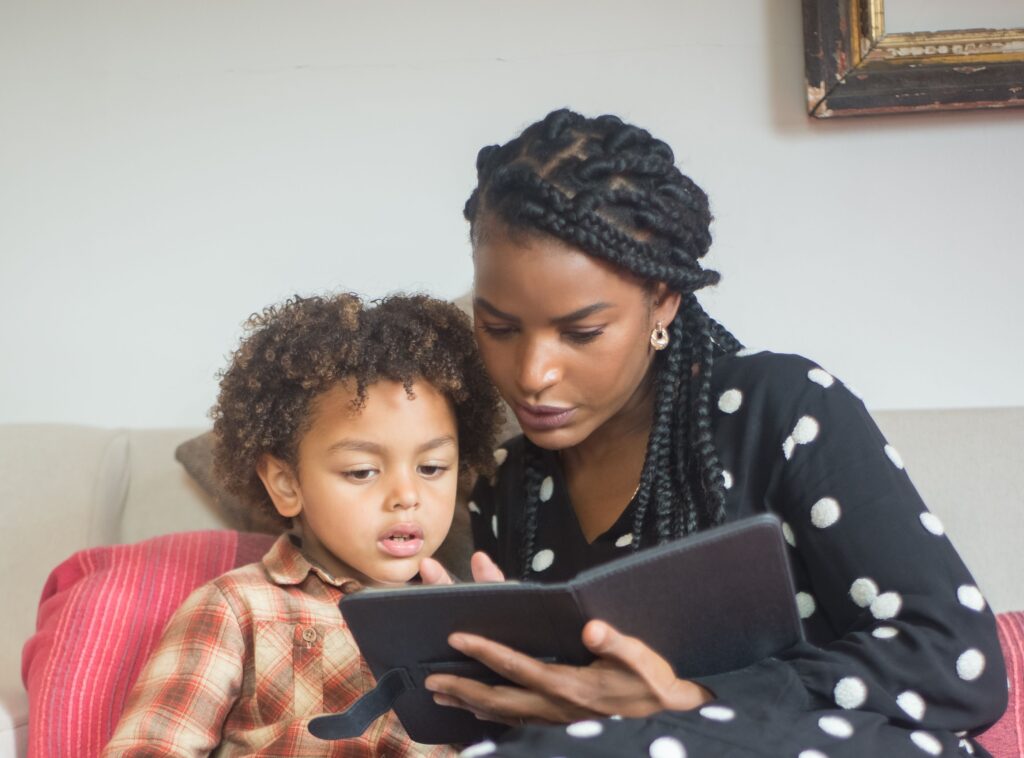
Foto de Kampus Production · Pexels
Author:
Cecilia V. Becerra Brito
Laboratory for Education and New Technologies (EDULLAB)
MAPFRE Foundation Chair in Technology and Education of the Canary Islands (TECNOEDU)