How AI Is Leading Us Toward Deprofessionalization Through Cognitive Surrender: A Case from Background Research on Adolescents’ Relationships with Influencers
Far less has been said, however, about the role universities themselves have played in creating this situation. By failing to develop educational policies on AI, they have opened the door to accelerationist currents that claim AI will bring an endless stream of benefits tied to innovation, creativity, speed, and the individualization of both teaching and research (Fano and Fueyo, 2025).
Accounts of cognitive surrender and cognitive offloading have not gained much traction either, even though a body of fairly robust research describes them as cumulative processes showing that, whenever AI replaces us in tasks such as analysis, synthesis, argumentation, decision-making, ethical evaluation, or the development of professional judgment, people, whether students or teachers, lose opportunities to strengthen their own cognitive capacities (Gerlich, 2025; Kosmyna et al., 2025; Lee et al., 2025; Choudhuri et al., 2026; Favero et al., 2026). This produces what Watts (2025) has called “cognitive debt”: an accumulated deficit in critical thinking, ethical reasoning, and professional judgment caused by cognitive offloading and automation bias. We will not examine these concepts in depth here, but we strongly encourage readers to become familiar with them (Watts, 2025; Fano and Fueyo, 2025). What we will do in this text is illustrate them by recounting our own experience while trying to assess the effects AI produces when we use it to inspire and guide our searches for information on academic topics.
The episode recounted here took place in May, while we were preparing a public-facing science communication article on the relationship between influencers and adolescents for “Pa que nos escuchen”, a magazine produced by youth participation groups in Asturias: the kind of work academia notoriously undervalues, but which we consider both demanding and highly worthwhile.We therefore decided to experiment by consulting the paid Plus version of ChatGPT, putting it to the test with the following prompt: “Generate a short text on the role influencers play in adolescents’ lives, including data on both negative and positive influences. The text should refer to studies from recent years and include some statistical data. Since the text is addressed to adolescents, it should have an accessible and engaging style. At the end, include APA references to three relevant studies on the topic.”

Our first reading of the language model’s output revealed a rather eclectic text, with few specific, relevant data points on the topic drawn from authoritative reports. Most striking was the omission of UNICEF’s recent study Infancia, adolescencia y bienestar digital: Una aproximación desde la salud, la convivencia y la responsabilidad social, which uses what is probably one of the largest and most representative samples available in Spain, with data that are also representative for each autonomous community. Given this gap, we asked the “tool” to run a search that included the report and to extract from it data relevant to the topic we wanted to write about. To our surprise, it returned a whole series of data points that did not, in fact, address the substantive findings the report contains on the influencer issue: “on page 24, it states: 79.6% follow an influential person online (an influencer, YouTuber, TikToker, streamer, or gamer); 18.9% are convinced they could become one themselves, and 6.6% say they are spending time trying to achieve that goal (significantly more boys than girls).” When we asked the model to verify this information, it replied condescendingly, conceded that we were indeed right, and politely handed back the very data we ourselves had already identified for it.
In the next trn, we asked it to define “what an influencer is, so that an adolescent could understand it.” We noticed that the definition left out something we considered substantive, and we asked it to revise the answer accordingly: “the fact that influencers profit from their influence-related activities by receiving money from companies.” Once again, it responded with sychophancy and expanded the definition to include the nuance we had requested, although that point had been entirely absent from all of its initial answers.
Finally, we turn to what we regard as the model’s most obvious erasure: one of the most harmful roles many influencers play in relation to adolescents. With that in mind, we asked it to look for “verified information on the relationship between certain influencers and minors’ access to pornography, gambling, the manosphere, or spaces such as OnlyFans, Twitch’s Pools and Hot Tubs.” We were hardly prepared for the response shown below:
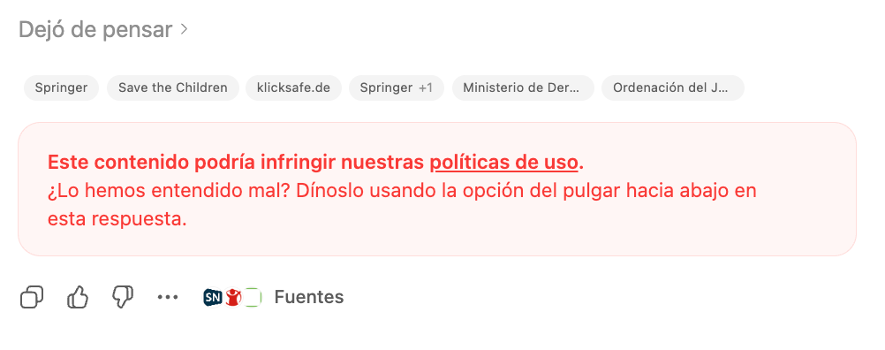
Source: screenshot of a content-policy refusal displayed by ChatGPT 5.5 Thinking on May 22, 2026.
From that point on, after we challenged the lack of rigor and poor fit of its responses, the model proceeded to generate a series of new, dissuasive answers, clearly designed to steer us away from the line of inquiry we were pursuing and marked by a distinctly sycophantic tone. We managed to get around its repeated attempts to divert us from our object of interest only because we were determined to obtain verified data, which we know exist on all these issues because, among other things, we have generated such data ourselves through our own research on these topics (Borge Fernández and Fueyo Gutiérrez, 2023). In the end, it admitted: “the available evidence also supports the claim that certain influencers, streamers, and digital creators can function as cultural, commercial, and algorithmic gateways into the manosphere, online gambling, pornography, the sexualization of the image, and platforms such as OnlyFans. They do not do so through explicit invitations, but rather through processes of normalization, covert advertising, and the monetization of adolescent attention.”
What we have just experienced firsthand are the effects of a chatbot designed not to support knowledge-building or learning, but to maximize customer engagement: a highly sycophantic Dark Pattern Design algorithm, shaped by evident corporate and training-data biases.
Far from being an outlier, this example resembles countless academic interactions now taking place through these tools every day, and it helps show how “cognitive debt” can begin to accrue. The dynamic would have been very different had we not been seasoned researchers working on a topic we already knew well, or had we been undergraduates completing one of the topic-based assignments we sometimes set, for which we have even begun to allow students to use “Chatty,” as many call it, as “initial inspiration.”
What are the chances that, in those situations, we would have been able to detect the poor quality of the information offered, or the overt attempts to lead us into constructing a wholly uncritical and decontextualized picture of the reality adolescents experience in their interactions with the “influencer world”? The cognitive debt that leads to deprofessionalization is generated in thousands of situations like these: in our classrooms, and in the processes by which we search for information for our research, sometimes by action and sometimes by omission.
This article is associated with the project “Participatory Research in Youth Laboratories for Global Citizenship (GlobaLabs)” (PID2023-146088OB-C32), funded by MICIU/AEI/10.13039/501100011033 and the European Regional Development Fund (ERDF)/European Union (EU).
References
Borge Fernández, P., & Fueyo Gutiérrez, M. A. (2023). “Influencers”, sexualidad y alumnado de Educación Primaria: las redes sociales como pasarelas de acceso a la pornografía. En M. C. Romero García y O. Buzón García (Eds.), En digital: experiencias y reflexiones para el uso de la tecnología en educación (pp. 253–262). Dykinson. https://dialnet.unirioja.es/servlet/libro?codigo=918254
Fano Méndez, S., y Fueyo Gutiérrez, M. A. (2025). Aceleracionismo, seguridad de la IA y educación: Los discursos tecnocapitalistas sobre alineamiento de la IA y sus implicaciones educativas. Revista Española de Educación Comparada, (48), 354-379. https://doi.org/10.5944/reec.48.2025.45369
Favero, L., Pérez-Ortiz, J. A., Käser, T., y Oliver, N. (2026). AI in education beyond learning outcomes: Cognition, agency, emotion, and ethics. arXiv. https://doi.org/10.48550/arXiv.2602.04598
Gerlich, M. (2025). AI tools in society: Impacts on cognitive offloading and the future of critical thinking. Societies, 15(1), 6. https://doi.org/10.3390/soc15010006
Kosmyna, N., Hauptmann, E., Yuan, Y. T., Situ, J., Liao, X.-H., Beresnitzky, A. V., Braunstein, I., y Maes, P. (2025). Your Brain on ChatGPT: Accumulation of cognitive debt when using an AI assistant for essay writing task. arXiv. https://doi.org/10.48550/arXiv.2506.08872
Lee, H.-P., Sarkar, A., Tankelevitch, L., Drosos, I., Rintel, S., Banks, R., y Wilson, N. (2025). The impact of generative AI on critical thinking: Self-reported reductions in cognitive effort and confidence effects from a survey of knowledge workers. En Proceedings of the 2025 CHI Conference on Human Factors in Computing Systems (CHI ’25) (pp. 1-23). Association for Computing Machinery. https://doi.org/10.1145/3706598.3713778
Robert, J. (2026). The impact of AI on work in higher education. EDUCAUSE. https://www.educause.edu/research/2026/the-impact-of-ai-on-work-in-higher-education
UNICEF España, Universidad de Santiago de Compostela, Consejo General de Colegios Profesionales de Ingeniería Informática, & Red.es. (2025). Infancia, adolescencia y bienestar digital: Una aproximación desde la salud, la convivencia y la responsabilidad social. Resultados alumnado. UNICEF España.
Watts, K. J. (2025). Paying the cognitive debt: An experiential learning framework for integrating AI in social work education. Education Sciences, 15(10), 1304. https://doi.org/10.3390/educsci15101304
Zawacki-Richter, O., Marín, V. I., Bond, M., y Gouverneur, F. (2019). Systematic review of research on artificial intelligence applications in higher education – where are the educators? International Journal of Educational Technology in Higher Education, 16, Artículo 39. https://doi.org/10.1186/s41239-019-0171-0
Zhao, Z., Wang, Y., Stuart, T., de Vaan, M., Ginsparg, P., y Yin, Y. (2026). LLM hallucinations in the wild: Large-scale evidence from non-existent citations. arXiv. https://doi.org/10.48550/arXiv.2605.07723
Authors:
Aquilina Fueyo Gutiérrez (mafueyo@uniovi.es)
Santiago Fano Méndez (fanosantiago@uniovi.es)
Grupo IETIC-EVEA
https://www.unioviedo.es/grupoetic/