The aConvive Project: Critical Digital Literacy and School Coexistence, Two Inseparable Areas of Learning
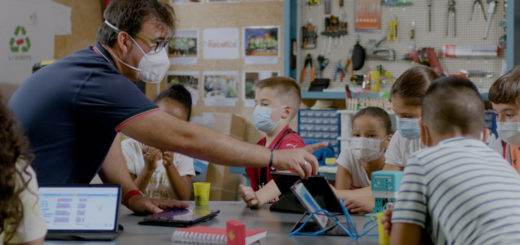
This scene, played out with variations across thousands of schools, is the starting point for the aConvive project (Critical Digital Literacy for School Coexistence). Its core hypothesis is simple yet powerful: problems of school coexistence related to digital technology use will not be solved as long as schools continue to treat Digital Competence as a set of technical and instrumental skills separate from students’ social lives.

In recent years, we have witnessed a steady stream of seemingly definitive solutions from educational authorities to digital challenges, all seasoned with competency-based learning frameworks and professional development programs that rarely promote deep reflection on the social role of these tools and platforms. Nor has their impact on relationships and coexistence been assessed from a systemic perspective, or how they affect the civic and democratic development of society.
At the same time, and because of the compartmentalization of knowledge in academic settings, the development of school coexistence has been addressed in a parallel and almost always decontextualized manner. The result is a kind of institutional double blindness: digital plans ignore coexistence, and coexistence plans ignore the digital dimension of conflicts.
The research team coordinated by Fernando Fraga Varela and Esther Martínez Piñeiro at USC proposes studying this gap as a focal axis with clear implications for students’ daily lives. Schools respond to cyberbullying, sexting, and problematic internet use with reactive and corrective interventions, applied to individual students after the damage has already been done. The proactive model, preparing students to recognize the power dynamics at work on platforms before they find themselves caught up in them, is rarely present. And this is partly because the digitalization of education is not neutral. It responds to the interests of large corporations seeking to turn schools into captive markets and data mines for surveillance capitalism.
Digital Competence, as it appears in most curricular frameworks, tends toward the instrumental: learning to use a word processor, knowing how to search the internet, handling a spreadsheet. It is a literacy for consumers, not for citizens. aConvive starts from a different theoretical stance, that of Critical Digital Literacy (CDL), whose central question is not only how to use media effectively, but how media changes the conditions of our existence.
From this perspective, learning to coexist in the 21st century necessarily involves uncovering the underlying mechanisms of power. For example, through the massive processing of user-generated data, its integration and exploitation in personalized recommendation algorithms that shape what each user sees. This prevents any understanding of new forms of manufactured consensus built through disinformation and dissolves any possibility of recognizing the economic and political power structures behind the platforms students use every day. Not as a separate subject, but as a cross-cutting dimension of the school experience.
The project goes far beyond a response based on banning screens — but also beyond an uncritical celebration of technology. It is a proposal to break out of that sterile dichotomy. Teaching students to navigate the digital ecosystem they already inhabit with critical awareness is far more ambitious and necessary than deciding whether or not cell phones should be allowed in the classroom — without, however, avoiding the debate about the appropriateness of devices or the apps that come with them, as well as their regulation.
aConvive recognizes the school as the best institution to prepare new generations to engage with a debate about how the power of digital platforms operates and to do so with autonomy and critical thinking. Understanding this reality opens the door for School Coexistence Plans and Digital Plans to stop separated documents drafted in parallel to meet a bureaucratic requirement, and to become expressions of a single Educational Project that rises to the challenge of a post-digital world where the boundaries between in-person and virtual no longer exist for students.
The answers will have to be built through rigorous research, collaborative work with schools, and the willingness to question the assumptions that have so far prevented digital competence and school coexistence from being seen for what they are: two sides of the same coin.
Authors:
Fernando Fraga Varela
Elena Fernández Rey
Stellae Research Group
University of Santiago de Compostela