Technological scenography in the art classroom: live drawing, visual storytelling, and improvisation as a pedagogical tool
Research context and institutional framework
The Elkarrikertuz group has traditionally focused its work on educational innovation, inclusion and the analysis of teaching practices in diverse contexts. In line with these areas of focus, the stay at the University of Madeira is intended to be a space for observation, collaboration and teaching experimentation, with a special emphasis on the diversity present among university students pursuing studies related to arts education. The experience takes place in the Artistic Drawing course, where drawing is not conceived solely as a technical skill geared towards the final result, but as a process of visual thinking and exploration of meaning. In this context, the act of drawing becomes a practice that articulates perception, decision-making and, above all, narration, providing an ideal framework for analysing the learning dynamics generated in the new university classrooms.
Diversity in university education in visual arts
University education in visual arts is characterised by the heterogeneity of the student body. Students with different backgrounds coexist in the same group: some have a background in academic drawing, while others approach the subject from intuitive or self-taught experiences. Added to this are differences in learning speeds, confidence when faced with a blank page, and the ability to verbalise creative processes. This diversity is not an obstacle; it represents a pedagogical asset. However, when teaching focuses on the final result or technical correctness, implicit inequalities can be reinforced. Students with more experience tend to feel more confident, while those who are unsure may become withdrawn.In this context, arts education takes place in a visual culture ecosystem where images circulate constantly and shape new forms of execution and perception (Freedman, 2003). Rethinking methodologies from an inclusive perspective means focusing not only on the product, but also on the process. Making visible how a drawing is constructed—decisions, changes, and doubts—allows us to demystify the idea of innate talent and open up spaces where students can verbalise what they are doing. Thus, diversity is no longer understood as a difference in levels but rather as a multiplicity of ways of doing things, and the pedagogical challenge consists of creating conditions for that plurality to be transformed into collective learning.
Basic technologies as mediators of creative learning
The incorporation of basic technologies such as projectors and document cameras does not respond to a logic of replacing manual drawing. Rather, these devices should be understood as pedagogical mediators capable of transforming the way we work and expanding the possibilities for interaction. Their introduction is linked to the cultural context of today’s students, whose relationship with the visual world conditions their forms of attention. In contrast, manual drawing can be perceived as a slow practice. However, the omnipresence of screens requires the creation of new pedagogical strategies so that artistic study can dialogue with these modes of attention (Bamford, 2006).In this sense, the document camera and projector function as a pedagogical setting that connects manual gestures with contemporary visual logic. Drawing on paper does not disappear; it is magnified and acquires a greater presence in the classroom. Through enlargements and framing, students try out solutions without losing the materiality of paper and line. This articulation between the analogue and the projected generates a hybrid space in which to create new forms of involvement.
Drawing and storytelling: the creative process as a shared practice
The teaching proposal was structured around the collective construction of a visual narrative. To this end, the class was arranged in a circle to create a sense of openness, where everything could be subjected to constructive criticism by both the teacher and classmates. Starting with an open theme, the group had to develop a story through successive interventions, with each student adding a graphic fragment that continued the story started by the previous student. Before starting, an order of participation was established by numbering, which allowed the sequence of interventions to be organised and the execution and observation times to be distributed.Knowing in advance when it was their turn to participate generated active anticipation. While one person drew under the document camera, the rest analysed the projected development, while also making preliminary sketches. The classroom functioned as a simultaneous space for thought: a visible action and multiple processes in preparation.
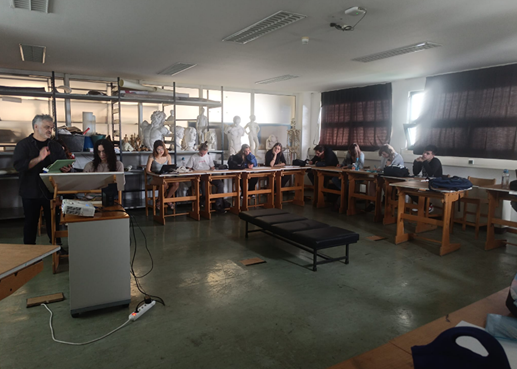
Figure 1. Layout of the art classroom
During the execution, the person drawing had to verbalise their drawing intentions, explain changes or justify compositional choices. This practice placed the students in an exercise of reflection in action, in the sense proposed by Schön (1983), where thinking occurs in relation to doing. Real-time projection turned individual drawing into a moving event, like an animation. Error was understood as a structural part of artistic learning, in line with Eisner (2002), shifting the emphasis to the quality of the process. Teacher interventions were formulated through open-ended questions that invited students to problematise the drawing in progress rather than offering closed solutions.
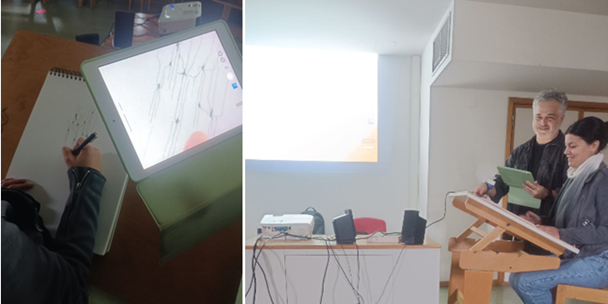
Figure 2. Development of creative drawing on the landscape. The student explains the technical development.
The sessions were recorded on video and uploaded to a platform shared among the students for later analysis. Reviewing the recordings, sketches, and field notes allowed us to examine the narrative evolution, as well as the impact of technological mediation on the students’ creative and communicative development. Finally, after these exercises, the students had to submit a personal story created at home that was related to the exercises recorded in class. What was assessed in class was the rapid creation of the drawing and the spontaneity in collecting sketches that would lead to the final result.
Conclusions: The classroom as a performance space and learning community
The incorporation of the projector and document camera transforms the spatial and symbolic configuration of the classroom, which is no longer organised around private productions but becomes a shared stage with a different attentional arrangement. This staging of recorded drawing also reconfigures the role of the teacher: the teacher acts as a mediator who asks questions, accompanies and encourages dialogue, in a redistribution of pedagogical authority close to Rancière’s emancipated spectator (2008), where learning involves actively observing, interpreting and producing meaning.The visibility of creative vulnerability, such as showing doubts, rectifying or reformulating, strengthens the group’s confidence and consolidates the understanding of drawing as a process. The classroom is thus configured as a hybrid space in which the manual and the projected, the individual and the collective converge. Improvements were observed in the students’ ability to explain and justify their actions: if at the beginning they drew without questioning their choices, at the end they began to argue them and construct richer narratives. The experience confirms that the use of basic technologies, integrated from a mediating perspective, does not displace manual practice, but rather expands its communicative dimension.
Narrative sequencing, simultaneous verbalisation and shared observation create an inclusive environment where diversity of rhythms and styles is recognised. Collective creation thus approaches relational dynamics in which the work is not a closed object, but a process of constructing meaning (Bourriaud, 2002), opening up new possibilities for pedagogical innovation in visual arts education.
References
Bamford, A. (2006). The wow factor: Global research compendium on the impact of the arts in education. Waxmann.
Bourriaud, N. (2002). Relational aesthetics. Les Presses du réel.
Eisner, E. W. (2002). The arts and the creation of mind. Yale University Press.
Freedman, K. (2003). Teaching visual culture: Curriculum, aesthetics, and the social life of art. Teachers College Press.
Rancière, J. (2008). The emancipated spectator. Verso.
Schön, D. A. (1983). The reflective practitioner: How professionals think in action. Basic Books.
Author:
Miren Arantza Gaztañaga Garabieta
Elkarrikertuz Group.