In the Key of Inclusion: How Music Trains Teachers in Life Skills
Introduction
In contemporary teacher education, mastery of academic content is no longer sufficient. Prospective teachers must also develop personal and social capacities that enable them to work with diverse student populations, manage complex situations, and cultivate more humane classroom environments. Among these competencies, three have guided this project—empathy, resilience, and prosocial behaviour—in alignment with the line of research we have been advancing (Cortón-Heras et al., 2023a).This piece presents a service-learning initiative arising from the collaboration between the University of Valladolid and the Special Education Centre “Nuestra Señora de la Esperanza” in Segovia (Spain). The aim was not only to enhance the education of university students, but also to respond to the real needs of an inclusive school (Parejo et al., 2021).
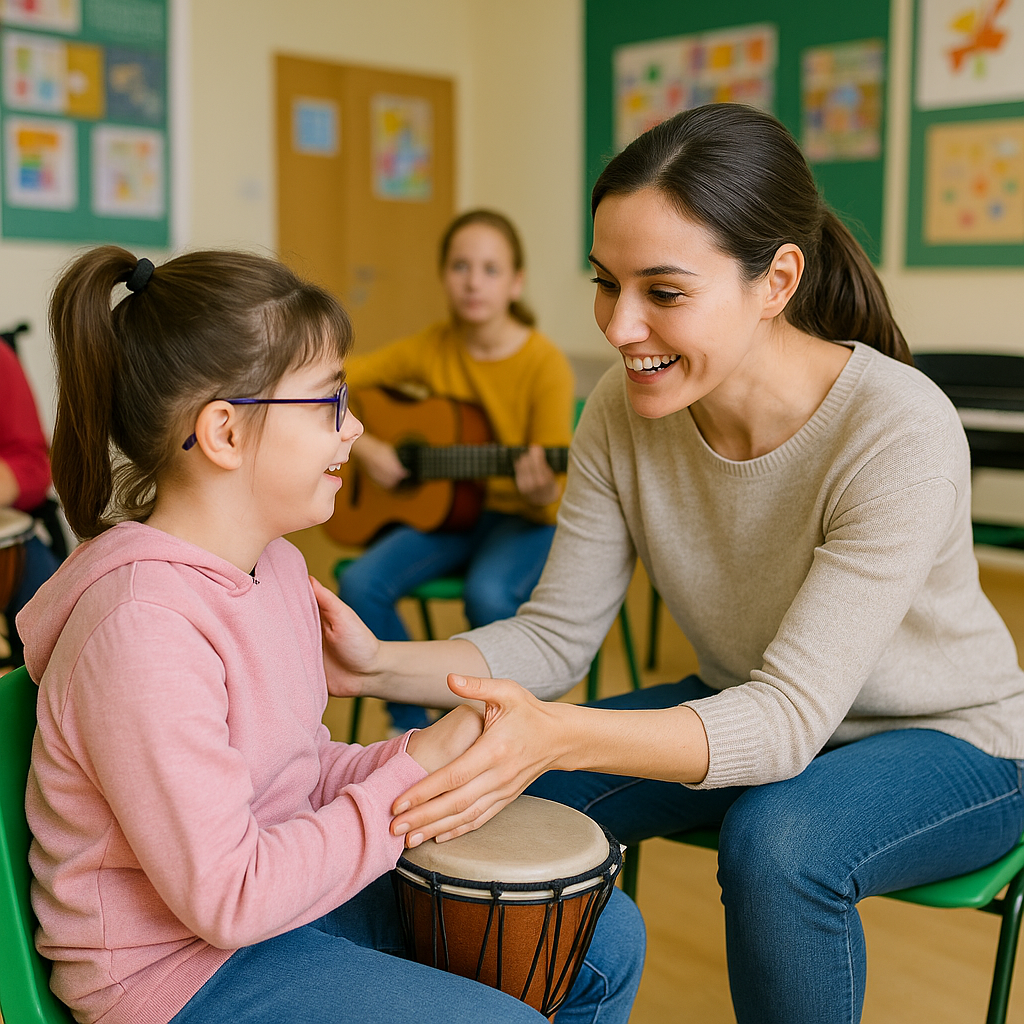
The service-learning methodology made it possible to articulate academic training with a meaningful contribution to the educational context. The musical sessions generated moments of emotional connection, enjoyment, and expression for the pupils at the centre, thereby reinforcing the social and pedagogical value of music. The university students designed, implemented, and evaluated their proposals; worked with the four modes of musical expression (creation, voice, instruments, and movement/dance); engaged in reflective journaling; and adapted their activities according to the group’s needs.
Why, then, should transversal competencies be developed in initial teacher education?
Life skills—such as regulating emotions, relating appropriately to others, solving problems, and adapting to adversity—have become indispensable for addressing the educational complexity present in today’s classrooms (Giraldez-Hayes and Prince, 2017). These capacities complement academic knowledge and strengthen personal wellbeing, decision-making, and effectiveness in teaching practice (Cortón-Heras et al., 2023b). Their importance is heightened in inclusive settings, where teachers must respond to diverse needs and foster learning environments grounded in respect, collaboration, and sensitivity to individual differences. Musical education, owing to its expressive, creative, and cooperative nature, provides a privileged space in which to cultivate these competencies in an organic and experiential manner.The Three Transversal Teaching Competencies Developed in the Music Education Project within an Inclusive Context
Empathy
Cnderstanding how others feel and responding with respect and sensitivity is fundamental in teaching. Analysis of the reflective journals reveals that music education significantly fostered the development of empathy among future teachers. Activities such as composition and collective improvisation facilitated emotional expression, understanding of others’ feelings, and cooperation within the classroom (Cuervo and Campayo, 2024).The students progressed from cognitive empathy—reading non-verbal cues, reinterpreting complex behaviours, adjusting communication—towards affective empathy, marked by the emotional connection that emerged through music. This experience enabled them to overcome initial fears, share moments of joy, and validate pupils’ emotions. Ultimately, they achieved compassionate empathy, expressed in concrete actions: adapting instruments, offering physical support, adjusting group dynamics, and extending care to the school’s teaching staff.
Overall, music acted as a powerful mediator in cultivating an inclusive, sensitive, and socially just teaching perspective.
Resilience
Lesilience involves adapting to challenges, maintaining emotional balance, and seeking alternatives when faced with difficulties. In music education, this capacity is essential for coping with unforeseen events, managing stressful situations, and responding to the complex realities of pupils’ lives (Munroe, 2022).In the project, resilience was expressed in several ways. First, through the management of technical and organisational contingencies: technological failures, group changes, or delays were handled with calmness, creativity, and improvisation. Second, through pedagogical flexibility, adapting instruments, materials, or dynamics to ensure inclusion (Parejo et al., 2021). It also emerged through emotional regulation, learning to cope with frustration and challenging behaviours with calm professionalism. All of this contributed to personal and professional growth, transforming mistakes into opportunities and reinforcing self-confidence..
Resilience was thus reflected in the capacity to face uncertainty and act with educational commitment.
Prosocial Behaviour
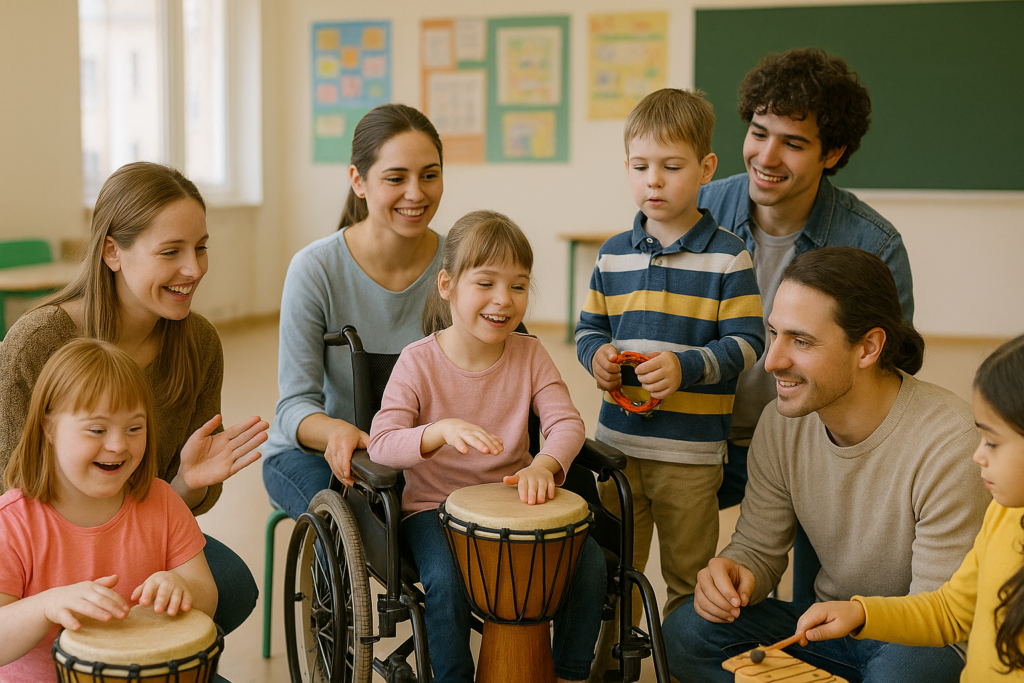
Larticipation in group musical activities has been associated with increases in prosocial behaviours in childhood—such as helping and sharing—confirming the educational value of music in promoting cooperation and community-oriented values (Ilari et al., 2020).In this project, prosocial behaviour emerged as a profound transformation in the professional identity of future teachers. It manifested in physical and inclusive actions—supporting pupils with reduced mobility, adapting instruments, removing barriers to participation—and in socio-emotional support, prioritising pupils’ self-esteem, wellbeing, and affective security.
Furthermore, the student group developed strong internal bonds of cooperation to resolve unforeseen issues and attend to those who needed the most assistance. This prosocial behaviour also extended to the school’s teaching staff, acknowledging and easing their workload whenever posible
Once again, music acted as a catalyst for an ethical, caring, and committed approach to teaching.
Conclusion
Lhe collaboration between the University of Valladolid and the Special Education Centre “Nuestra Señora de la Esperanza” of Segovia has become a valuable model for developing transversal competencies in future teachers of Music Education. This experience not only fostered the growth of empathy, resilience, and prosocial behaviour but also provided a direct response to the needs of a diverse student population, generating inclusive and meaningful learning environments. Looking ahead, it is essential to continue strengthening this partnership and to build a stable network of inter-institutional collaboration that ensures initial teacher education remains connected to the increasingly diverse, complex, and evolving realities of schools.The project has left a profound mark on participating students while also having a positive impact on the educational centre itself, promoting a shared culture of learning, empathy, and cooperation.
The collaboration between the University of Valladolid and the Special Education Centre of Segovia has become a valuable model for developing transversal competencies in future teachers of Music Education. This experience not only fostered the growth of empathy, resilience, and prosocial behaviour but also provided a direct response to the needs of a diverse student population, generating inclusive and meaningful learning environments. Looking ahead, it is essential to continue strengthening this partnership and to build a stable network of inter-institutional collaboration that ensures initial teacher education remains connected to the increasingly diverse, complex, and evolving realities of schools.
The project has left a profound mark on participating students while also having a positive impact on the educational centre itself, promoting a shared culture of learning, empathy, and cooperation.
References
Corton-Heras M.O., Giraldez-Hayes A., Soliveres-Buigues R., & Parejo J.L (2023a). The Mediation of Music in the Development of Intrapersonal and Action Skills in Early Teacher Education. Qualitative Research in Education, 12(2). 116-148. https://doi.org/10.17583/qre.10748
Cortón-Heras, M. de la O., Monreal Guerrero, I. M., & Parejo, J. L. (2023b). La mediación de la música en el desarrollo de las habilidades interpersonales en la formación inicial del profesorado. Artseduca. https://doi.org/10.6035/artseduca.6827
Cuervo, L., & Campayo, E. (2024). The potential of group music education fordeveloping empathy: An empirical study. Psychology of Music, 52(6), 668–684.https://doi.org/10.1177/03057356231183873
Giraldez-Hayes, A., & Prince, E.-S. (2017). Habilidades para la vida: Aprender a ser y aprender a convivir en la escuela. Ediciones SM.
lari, B., Helfter, S., & Huynh, T. (2020). Associations between musical participation andyoung children’s prosocial behaviors. Journal of Research in Music Education, 67(4),399–412. https://doi.org/10.1177/002242941987816
Munroe, A. M. (2022). Novice and experienced music teacher resilience: A comparative case study. Studies in Music Education, 44(1), 99–109. https://doi.org/10.1177/1321103X211023248
Parejo, J.L., Cortón-Heras, M.O., & Giraldez-Hayes, A. (2021). La dinamización musical del patio escolar. Revista Electrónica Complutense de Investigación en Educación Musical,(18), 167-194. https://doi.org/10.5209/reciem.69734
Authorship:
María de la O Cortón de las Heras
Department of Didactics of Musical, Visual, and Physical Expression
University of Valladolid
José Luis Parejo
Department of Pedagogy
University of Valladolid
Research Group ICUFOP